"Out of Order"
How to live with a broken order of loss, and the hierarchy of grief.

Start writing…that’s what my screen says on Substack when I stare at a blank, new page; poised and ready to write. Start writing. A command from the Substack god’s (lowercase g). Just start. Go ahead. It isn’t hard. Do it. I double-dog dare you. Sometimes writing comes easily, like breathing. It’s a release. At other times, I feel like a tooth, rooted too deeply into the gums of a twelve-year-old sitting in a dentist’s chair, as they desperately try to make room for something new to grow; something grown-up, something permanent.
Let’s talk about losing teeth. There’s a general order to it. You turn six years old, and your teeth fall out. Okay, I guess there’s not a ton of order…that’s kind of it. But it’s still pretty predictable, right? You might need a tooth pulled, or you might need braces (nothing and no one is perfect), but for the most part, the loss is inevitable and semi-predictable.
Confession: I don’t really want to talk about teeth. I want to talk about my brother.
I am statistically three times more likely to die via suicide because of my brother. And so are all of my siblings, which is an even scarier statistic than the first one (at least scarier for me to read, even if they’re technically the same odds). I’ve started reading research papers on how life changes for siblings of suicide victims. I don’t know why I hadn’t done this sooner; it makes me feel a different kind of “seen.” The kind of seen that’s been peer-reviewed; professional validation.
In the paper I reference throughout this Substack, “Lived Experiences of Individuals Bereaved by the Suicide Death of a Sibling” by Abossein et al., the first thing that I noticed was that the majority of research respondents were female. Sisterhood in grief. I wonder why? Participants ranged from 35 years-old to 81…both ages seem distant to me, and yet I see myself in them both. I feel less alone in this way. It makes me wonder, though, how lonely surviving brothers feel. One of this particular study’s limitations was the obvious gender inequality, due to many male participants declining to be audiotaped and wanting to fill out a written questionnaire, which was not an option. This lack of adequate gender distribution paints a picture of a hurting man who lost their sibling, wanting to speak without a face or a stage…and being denied that.
The second thing I noticed was a phrase: “The Hierarchy of Grief.” There’s a social focus (one that seems rightful, if I am honest) on the deceased’s parents, spouse, and children. These are the people we assume “lost” the most, and are the most emotionally affected. No parent should ever have to lose a child, and no child a parent. Losing a life-partner is its own scarring experience that we can all agree leaves us feeling empty and disenchanted. The siblings of the deceased, however? They tend to get lost in the chaos. At times, we even minimize our own grief by building a pyramid hierarchy of what feelings are valid, from whom, and when they should have the mic (spoiler alert: we siblings rarely take the mic — and no one gives it to us).
So, what happens? In 1961, George Engle compared the psychological trauma of a significant loss to a physiological wound (as cited in Freeman, 2005). I think if the pain of my brother were to manifest itself in my body, it would be in my ribs and my right arm. Lucky for me, this loss is mostly contained to the nauseatingly beautiful universe around me and every poem I hear. Ten years in this world without my brother, and here are a couple of my biggest takeaways, right now, on a random Wednesday night (or whenever I finish writing this; I’m practicing the long-form writing process — taking my time, editing, and then taking some more time to digest my feelings).
Once you’ve experienced an unexpected, “out of order” kind of loss, you start to see loss everywhere. Change can seem like loss. For those grieving, it can seem like a reflection of that loved one. I think that some of my family see my brother Dan in change, like seeing a ghost. And they see him in all change, even if it’s net-positive change. They see the light under his door and hear him cooking in the kitchen when I say that I’m moving. They’re reminded of his absence when it gets dark out, and I’m not home yet. And maybe they think about how lonely he must have felt whenever I bring home someone new in my life. Change is like his ghost, haunting every shift towards something other than what used to be. Change, after an “out of order” death, is hard, and I want to have more grace for that. For myself, and for my family.
The second thing that happens: you realize you're a part of an unfortunate club. You didn’t apply to be in this club; there’s no chair or president or fun lunch parties — you find yourself in this club suddenly and without a say. You’re inducted when your sibling dies via suicide. As someone who has been a member of this club for a decade now, I must warn you: once you’re in, you look for other members everywhere you go. Not consciously, but the minute you meet someone who is in the club, you will feel compelled to tell them you’re a member. You’ll feel the need to run up to them and say, “omg, hi! I’m a member of this club, too! Doesn’t it suck?! What’s your name!? What was their name?! How’d they do it?!” It’s great. It really is. I love meeting fellow members. So, if I awkwardly approach you one day after stalking your social media that happened to pop up on my Facebook, displaying a post about your late brother: please don’t be weirded out when I know before you tell me, and have already started the induction process. It’s just something I have to do. It’s the code of our club. We have to give each other mics.
Another thing happens when you become a member of this club: you start to care about words a lot more. Take the term “committed suicide.” “Committed” is an interesting word. In this context, it implies a breaking of the law. Did you know that suicide wasn’t decriminalized until the 70’s? Yeah, me neither. I actually wasn’t completely aware that suicide was a prosecutable infraction at any point in time. I mean, who are you gonna arrest? Good luck putting cuffs on those wrists… (sorry, dark joke; another side effect of being a member of this club). Suicide seems like a consequenceless crime for the one committing it. However, with this decriminalization, there has been a push to find different terminology for this kind of act/experience. “He experienced suicide,” “they died by suicide,” “she took her own life.” These kinds of terms soften the action and help minimize the stigma associated with attempts. This is a great thing for those who have survived suicide attempts, as it helps reduce a lot of shame surrounding the topic. However, surviving loved ones of a suicide death are affected by a terminology switch, too. Part of me cringes at saying “committed suicide” because it feels like blaming. I don’t blame my brother. I’m not mad. He didn’t do anything “wrong” (and I hate that I have to air-quotes that because I think I’m still trying to convince myself it’s true). However, all of these other alternative terminology options don’t rightfully encapsulate the shocking experience of the surviving loved one. So, the words I use end up changing depending on the day. “He took his own life” comes out to softer individuals that I don’t want to traumatize, but those words can feel minimizing to my own grief. “Committed suicide” is the only phrase that communicates my pain, my grief, and my experience. How I word this tells people not only what happened to my brother, but what happened to me, and how I carry it today. I don’t blame my brother, but I don’t feel seen in soft words. I live in that tension.
In the end, we can read all of the research papers we want, and survey to our hearts’ content, and we’ll really just be systematically dancing around the core truth of it all: there’s a socially accepted order to loss. And when that order is disrupted, our social, biological, and psychological systems glitch. The moral of the story is this: we innately know it isn’t normal. We expect to lose our grandparents and know our parents will someday follow. Our spouse’s death is even on our minds; distant, but real. Our siblings, though? We grew up with them. We’re the same age, more or less. We’re the same cohort of humans. We’re supposed to have them our whole lives, until we are on our own deathbeds. We grow with them as the backing track of our lives. When they’re gone, the static feels eerie; not quite right. It’s okay to feel that way. Because you’re right. You should have had a sibling with whom you could grieve the losses of life. Instead, they became that loss, that grief, and because of it, everything else seems up for grabs. You live your life in a state of constant anticipation of the other boot to drop. Life feels great? Everyone’s happy and healthy? Your parent is about to die. Achieved that goal you were praying for? Say goodbye to your car because it’s about to get totaled (true story). Getting back in the gym? Cue crippling depression because of the chemical imbalance normalized in your brain that gives cortisol (an old comforting friend) the center stage. When tragedies are the soil from which you grew, your nervous system feels most safe when the worst has happened. You’re looking for the next bad thing because that is your comfort. That’s your safety net; after you’ve already fallen.
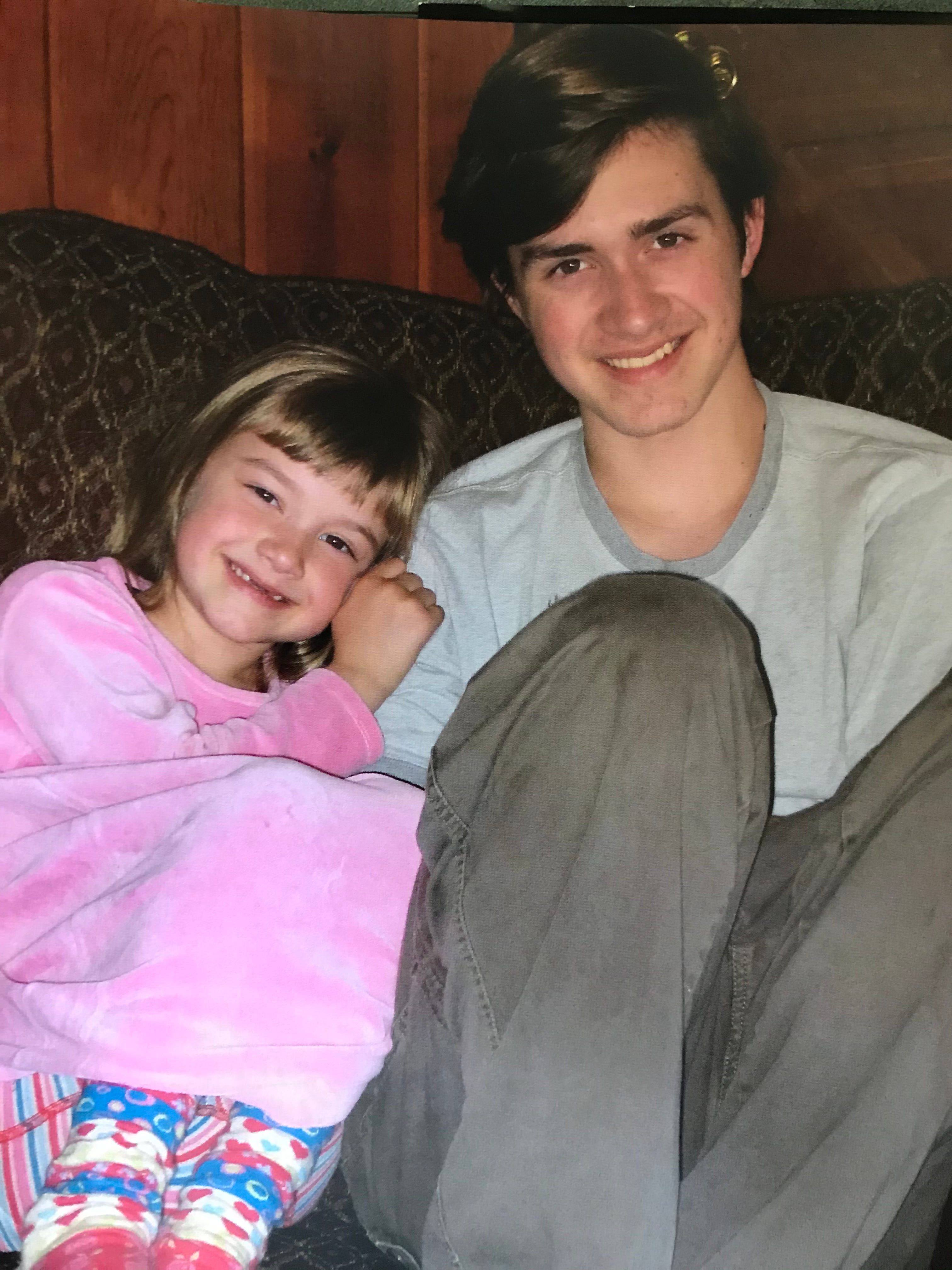
Before I close this open letter to the world…if you, dear reader, happen to be a part of this unfortunate club, and you’re feeling discouraged, grasping for a listening ear or an untangled thought, I need you to hear one thing: there’s something beautiful that I’ve done (and you can do, too). In fact, there’s a beautiful thing that many of the participants in Abossein et al.'s study have also done: created a new world. I do it every day — with my brother. Yes, that’s right. The same brother who took his own life ten years ago. He and I have built together a pretty impressive world. A world in which he blinks on occasion and sings softly the colors of his soul. This new world is one created with the deceased: a flurry of mostly mundane explosions of nostalgia and pain filtered through stained glass, hummingbird-feeder love. My new reality is shaped just as much by my brother as it is by me. I see and hear him in so many things. I hear him in The Fratellis’ song playing inside a little shop in Greece, as I walk past it down the colorful street in a country I’ve never been to before. It carries on the wind, and I smile. Hi Dan. I see him in crows, cattails, chlorine, drums, and Dr. Pepper. Tasting him in every carbonated sip (especially from a can). I see him in pipes, smoke rings, ponds, foggy days, black umbrellas, Carls Jr., electric guitars, sunscreen, fingerless gloves, long coats, chicken sandwiches, children’s books, beautiful art, long hair, Canada, gray vests, Halo, Fort Bragg, shadow puppets, olive trees, dead birds with ants, really good impersonations, Leonard Nimoy, lemons, chicken piccata, Shirley Temples, purple evenings, Adventure Time, corroded guitar strings, my niece Charlotte, my nephew he never met, gray sweatshirts (with holes), tennis shoes, myself in the mirror sometimes, home movies, my mother, the science of stars, and imperfect teeth. All of it. He’s in all of it. And I am so thankful for this messily beautiful world we have created together these past ten years. Thanks, Dan.
Trust me: the world you get to create alongside your lost loved one is worth the pain it takes to build it.
Grief is my permanent tooth. My life as it was has been pulled out by what felt like a not-so-skilled dentist, and room has been made for something new to grow, something permanent: grief. It has grown steadily and fully into place, but I’m still learning how to chew. As is the usual case with change and loss and growth, our smiles look different from what they once did, but after a good cry, and with the occasional toothache, we still manage to have them. All with room to grow.